
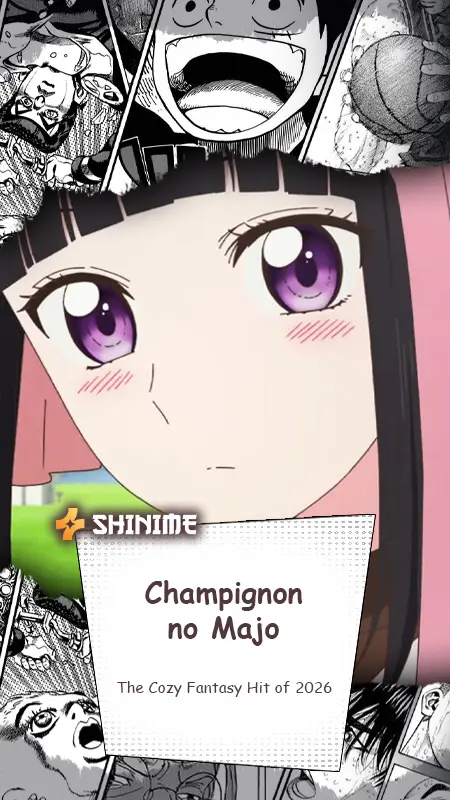

We’ve all seen witches in anime. Usually, they fly on broomsticks, chant incantations, and usually end up saving, or accidentally destroying, the world. Even when the setting changes, the role rarely does.
Champignon no Majo breaks that mold almost immediately.
Instead of explosive magic or grand destinies, this anime introduces us to a witch whose defining passion isn’t power, prophecy, or rebellion, it’s mushrooms. Not as a gimmick or a visual flourish, but as the emotional, thematic, and narrative backbone of the entire story.

What sounds like a novelty concept quickly reveals itself to be one of the most thoughtful, quietly inventive fantasy anime in recent years. Champignon no Majo (The Witch of the Mushroom) doesn’t shout to get your attention. It invites you to slow down, look closer, and appreciate the small systems that keep a world alive.
If you’re exhausted by high-stakes escalation and endless power ceilings, this anime feels like a deep, necessary breath.
What Is Champignon no Majo About?
At its core, Champignon no Majo follows Luna, a young woman labeled a “Black Witch” and forced to live in a poisonous forest far from human settlements. The villagers fear her not because of anything she has done, but because of what the title implies. Black magic, decay, and danger are assumed, understanding is not.
The reality of life in champignon no majo is far less dramatic. Luna is simply a deeply curious, socially awkward researcher with an intense fascination for magical fungi. She studies spores the way other witches study spells, documenting their growth, reactions, and effects on the surrounding ecosystem.
Her long-term goal is deceptively simple: to complete her grimoire by cataloging 1,000 unique magical mushrooms. That number isn’t just a goalpost. It’s the structural engine of the anime.
Each discovery functions as a self-contained story beat, revealing something new about the forest, the magic system, or Luna herself. Some mushrooms provide light. Others neutralize curses. A few behave in ways that are deeply inconvenient and occasionally horrifying. What matters is that every entry has purpose.
Rather than feeling like a repetitive fetch quest, Luna’s work gradually builds a coherent, living world.
Champignon no MajoStory and World-Building
One of the most impressive achievements of champignon no majo is how alive its world feels without relying on exposition-heavy dialogue. The forest Luna inhabits is not just a backdrop; it behaves like a complex biological system unique to the lore of champignon no majo. Fungi react to changes in mana density, creating an environment where nature itself dictates the narrative flow. Decay is shown not as rot, but as transformation. Even silence feels intentional, as if the environment itself is listening.
Early episodes of anime champignon no majo lean into a healing, almost meditative tone. Luna wanders through glowing undergrowth, stops to observe subtle changes in spore behavior, and records her findings with genuine excitement. These moments establish trust: the anime is telling you that it values patience and attention.
As the story progresses, that patience is rewarded.
Champignon no Majo Official Trailer
The significance of Luna’s 1,000-mushroom goal slowly expands beyond personal fulfillment. The anime begins to hint that the forest’s balance, its ability to sustain life, magic, and even human settlements, depends on the completion of her work. The mysterious “1,000th mushroom” isn’t just rare; it’s foundational.
What’s impressive is how gently the stakes rise. There’s no sudden tonal shift into bombast. The anime remains cozy, but the meaning behind Luna’s actions deepens. Saving the world, it turns out, can look like cataloging it properly.
Themes: Fear, Knowledge, and Coexistence
Champignon no Majo is thematically rich without being preachy. Its ideas are embedded in routine actions rather than speeches. A recurring theme is the fear of the unknown. The villagers’ distrust of Luna in champignon no majo mirrors how people often react to poisonous mushrooms or unfamiliar ecosystems, with destruction instead of curiosity. The anime never frames this fear as villainy; it frames it as ignorance.
Another central theme is coexistence. Magic in this world isn’t about domination or mastery. Luna doesn’t bend nature to her will. She negotiates with it, studies it, and adapts to it. Power comes from understanding systems, not overriding them.
Perhaps most quietly powerful is the anime’s treatment of knowledge as kindness. Luna’s expertise saves lives not through combat, but through preparation and care. Remedies, brews, and preventative solutions take precedence over flashy heroics. It’s a rare fantasy narrative that treats competence itself as a moral good.
An Experimental Format That Actually Serves the Story
One of the most talked-about aspects of Champignon no Majo is its unconventional episode structure. Instead of standard-length episodes, the anime adopts a micro-episode format inspired by its central number. Episodes are shorter, tighter, and focused around singular ideas or discoveries. On paper, this sounds risky, possibly even gimmicky.
In execution, it works remarkably well.
The shorter runtime reinforces the anime’s tone. Each episode feels like a journal entry or a field note rather than a dramatic chapter, a style that suits the narrative of anime champignon no majo perfectly. There’s no filler, no artificial padding. You’re given just enough time to absorb an idea before moving on.
That said, this approach won’t work for everyone. Viewers who prefer long, immersive episodes may find themselves wishing for more time to linger. But for a story built around observation and incremental discovery, the format feels intentional rather than restrictive.
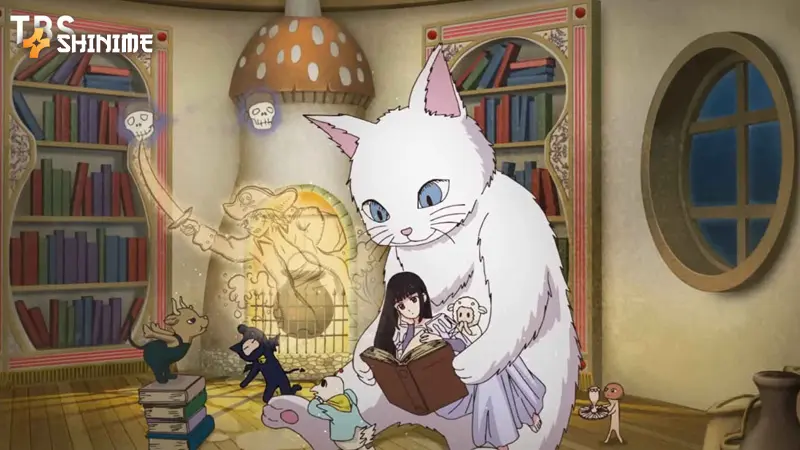
Visual Direction and Sound: Organic, Not Flashy
Visually, Champignon no Majo is stunning in a restrained way. The mushrooms themselves are the stars. They glow with neon blues, purples, and greens that contrast beautifully against the forest’s dark, earthy tones. Magic manifests as drifting spores and subtle environmental changes rather than explosive effects. Everything feels fluid, organic, and grounded.
The animation prioritizes atmosphere over spectacle, a choice that allows the forest to feel tactile and alive. This stylistic direction sets anime champignon no majo apart from standard fantasy series. The soundtrack complements this approach perfectly, avoiding sweeping orchestral themes in favor of ambient textures that match the show’s grounded energy.
Characters: Small Cast, Strong Identity
The series keeps its cast intentionally limited, and that restraint pays off. Within the quiet narrative of champignon no majo, Luna serves as a refreshingly grounded protagonist. She isn’t chosen by fate or driven by revenge; she is driven by pure curiosity, making her the perfect vessel for the audience to explore this poisonous yet beautiful world. Socially awkward, deeply intelligent, and unapologetically obsessive about her field, she feels more like a real researcher than a fantasy archetype.
Watching her light up over a rare fungal strain is oddly infectious. Her joy is specific, and that specificity makes it believable.
Supporting characters appear sparingly. Luna’s familiar and the forest’s creatures provide most of the interaction, while occasional villagers and rival foragers serve as mirrors for the audience’s assumptions. As they learn to see Luna differently, so do we.
Humor and Emotional Payoff
Despite its gothic aesthetic, Champignon no Majo is often very funny. The humor tends to emerge naturally from situations rather than punchlines. One standout moment involves a chain reaction of sneeze-inducing mushrooms that spirals into pure slapstick chaos, a rare burst of physical comedy that feels earned because of the anime’s otherwise calm tone.
On the emotional side, the series excels at quiet moments. A particularly memorable scene involves Luna sharing a medicinal brew with a sick villager. There’s no grand apology or dramatic reconciliation. Just soup, silence, and understanding. It’s understated, and that’s why it works.
Reception, Comparisons, and Audience Appeal
Since its release, Champignon no Majo has developed a dedicated following online. Fans delight in spotting hidden mushroom details in background art and sharing screenshots of particularly beautiful frames. Its visual identity makes it highly shareable, while its tone encourages repeat viewing.
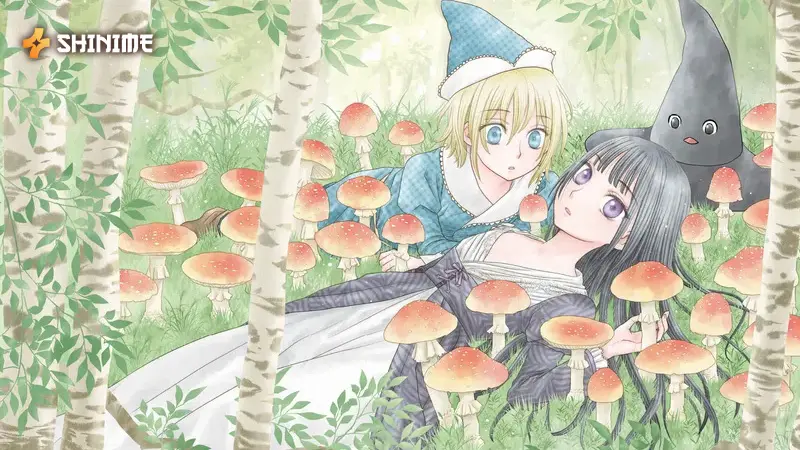
In terms of comparisons, anime champignon no majo sits comfortably alongside cozy fantasy anime, but with a darker, more biological edge. If you enjoy slower-paced witch stories but want something more conceptually ambitious, this anime fills a very specific niche.
Final Verdict: A Rare Kind of Fantasy Anime
Champignon no Majo doesn’t try to impress you. It trusts you. It trusts you to slow down, to pay attention, and to care about small systems rather than grand finales. In doing so, it delivers one of the most quietly satisfying anime experiences in recent memory.
This is a show about curiosity, patience, and the beauty of understanding what others choose to fear.
Final Score: 9/10
Ready to get spooked and soothed at the same time? Go give the anime a watch, it’s the perfect weekend binge. And for more updates on season renewals, experimental anime formats, and everything else in the otaku world, make sure to read more anime news at Shinime Anime. Don’t let this one rot in your queue!